

Zirconia crowns are widely used in modern dentistry due to their excellent strength, durability, and esthetics. However, their high fracture resistance also makes them one of the most difficult restorations to remove when replacement or retreatment is required.
Whether a crown fails due to secondary caries, endodontic complications, marginal defects, or prosthetic redesign, clinicians must remove the zirconia restoration while preserving as much healthy tooth structure as possible.
Understanding the correct clinical technique and instrument selection is essential to remove zirconia crowns efficiently without damaging the underlying tooth.
Why Zirconia Crowns Are Difficult to Remove
Zirconia is one of the strongest materials used in restorative dentistry. Its high flexural strength and fracture toughness make it extremely resistant to conventional crown removal techniques.
Unlike porcelain-fused-to-metal crowns, zirconia crowns:
-
cannot be easily cracked with crown spreaders
-
resist fracture during removal attempts
-
require controlled sectioning before removal
For this reason, dentists typically rely on high-speed rotary instruments to section the crown before lifting it from the tooth.
Step-by-Step Technique for Removing Zirconia Crowns
1. Identify the Crown Thickness
Before beginning removal, evaluate the restoration carefully using clinical examination and radiographs.
Important factors include:
-
crown thickness
-
cement type
-
margin design
-
adjacent restorations
Understanding these factors helps determine the safest approach for sectioning the crown.
2. Section the Crown Using a High-Speed Bur
The most effective technique for removing zirconia crowns is controlled crown sectioning.
A high-speed handpiece with adequate water spray should be used to create a vertical groove along the crown surface.
The goal is to:
-
weaken the zirconia structure
-
expose the cement interface
-
allow controlled separation of the crown
For this step, dentists often use a transmetal carbide crown cutter, which is specifically designed to cut through strong restorative materials such as zirconia, metal, and ceramic.
For example, the FM12 Transmetal Carbide Bur FG Crown Cutter is designed for efficient crown sectioning. Its cutting geometry allows dentists to create precise grooves through zirconia crowns while maintaining good control during the procedure.
Because zirconia generates significant heat during cutting, continuous water irrigation is essential to prevent thermal damage to the tooth.
3. Deepen the Groove Carefully
Once the initial groove is created, the bur can be used to gradually deepen the cut until the underlying cement layer becomes visible.
During this stage, clinicians should proceed carefully to avoid cutting into the tooth structure.
Indicators that the groove is deep enough include:
-
visible cement layer
-
slight color change between zirconia and cement
-
reduced resistance during cutting
4. Use a Crown Spreader to Fracture the Crown
After the crown has been sufficiently weakened by sectioning, a crown spreader or crown remover can be used to gently apply force along the groove.
This step helps:
-
fracture the crown along the weakened line
-
release the cement seal
-
allow removal of the restoration
Once the crown splits, it can usually be removed easily without damaging the tooth.
Tips for Efficient Zirconia Crown Removal
Although zirconia crowns are strong, the removal procedure can be efficient when the correct approach is used.
Use Proper Water Cooling
Continuous water spray prevents overheating and improves cutting efficiency.
Apply Light, Controlled Pressure
Allow the bur to cut progressively rather than forcing the instrument through the crown.
Follow the Crown Contour
Sectioning along the crown’s natural contour reduces the risk of damaging the tooth.
A Practical Option for Crown Removal Kits
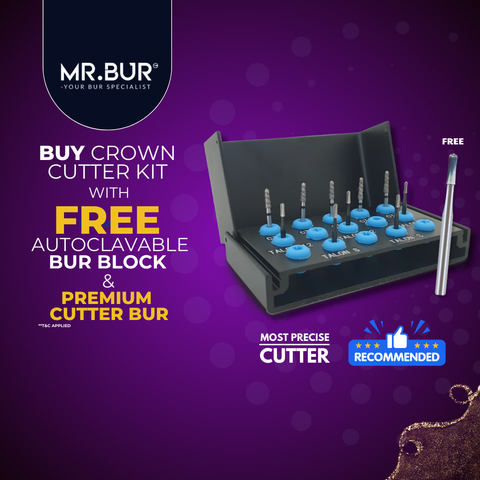
For dentists who frequently perform crown removal procedures, using a dedicated crown cutter kit can improve efficiency and convenience.
Instead of selecting individual burs each time, a kit provides a selection of instruments specifically designed for sectioning different types of crowns.
The Mr. Bur Crown Cutter Kit for Crown Removal includes specialized burs designed for cutting through tough restorative materials such as zirconia and metal crowns. Having these instruments prepared in a single kit can simplify workflow and ensure the appropriate bur is available when needed.
This can be particularly helpful for clinicians who regularly manage failed restorations or crown replacements.
Final Thoughts
Removing zirconia crowns requires a careful balance between efficiency and preservation of tooth structure. Because zirconia is extremely durable, the most predictable approach involves controlled crown sectioning using appropriate carbide crown cutters.
By creating a precise groove, weakening the crown, and then separating it with a crown spreader, dentists can remove zirconia restorations safely without damaging the underlying tooth.
When the correct instruments and techniques are used, zirconia crown removal becomes a predictable and efficient procedure in restorative dentistry.
In the United States, from Chicago to Los Angeles, dental practices are shifting toward streamlined composite polishing techniques that reduce chair time while enhancing results. American clinicians continue to invest in systems that support high-quality, esthetic outcomes for every patient.


